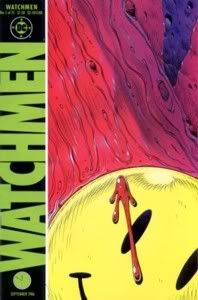
Title: WATCHMEN
Publisher: DC Comics
Type: Graphic Novel/Comic, Paperback, 416 pages
Language: English
ISBN-10: 0930289234
ISBN-13: 978-0930289232
“... noui
consilia et ueteres quaecumque monetis amici,
'pone seram, cohibe'. sed quis custodiet ipsos
custodes, qui nunc lasciuae furta puellae
hac mercede silent? crimen commune tacetur.
prospicit hoc prudens et a illis incipit uxor.”
Juvenal's Satire VI, "Against women" (6.O29-34) (c. AD 60–127)
“sed quis custodiet ipsos custodes?” This is what Juvenal asks of the reader, “but who watches the watchmen?” When Alan Moore took this line and worked it into a project he was working on with artist Dave Gibbons, I doubt he thought that it would be a phrase that would become ingrained in the minds of funny book nerds the world over. The year is 1985 and a man has been murdered, apparently thrown from the window of his high-rise apartment. Two New York City Police detectives muse over what could have happened. However, this is not a simple murder mystery and this is not the 1985 that you know of. For one thing, “super heroes” are quite real in this world, though they are far from “super,” and their activities are often far from moral. For another thing, there is a naked, blue, glowing man who can manipulate matter at a sub-atomic level with (what we lesser beings would consider) his mind. This is the world of WATCHMEN. While many comics had had costumed freaks beating up criminals in the past, WATCHMEN handled them in a different way. They were not holier than thou, muscle bound, macho men with ridiculous powers and a damn fine set of chompers. They are sexual deviants, murderous sociopaths, and sad people who have lost touch with reality. It is this key element that, in my opinion, separates WATCHMEN from all other superhero comics. While Spawn tries to be more “real” and “gritty” by having a lot of blood and naughty words, WATCHMEN was more “real” and “gritty” by focusing more on the characters than on their actions.

Moore’s superheroes all have their own personalities; they seem to be actual thinking, breathing, human beings, even if you would never want to meet most of them. Rorschach, the proverbial “fan-favorite” for obvious, however superficial, reasons, is quite simply a right wing, mass murdering, homicidal maniac. He was born to a single mother, which makes sense, as she was a prostitute by trade. As an adult, Rorschach put on a white, latex mask, which was covered by constantly shifting black shapes and began fighting crime.

Another influential player in the story is the man known as Dr. Manhattan. After an accident at a government research and testing facility in 1959, Jon Osterman was transformed into a living god. The only super powered being known to man, Jon quickly found himself as the centerpiece of America’s foreign policy. Dr. Manhattan is also one of two costumed vigilantes who remain active after the Keene act, an emergency bill outlawing all non-government sponsored masked adventurers, that was passed by congress in 1977.

Laurel Jane Juspeczyk, or just Laurie, is the daughter of Sally Jupiter, the woman who is more commonly known as the first Silk Spectre. The only reason that Laurie ever put on a black, yellow combo was because her mother forced her to. Too old to continue fighting crime, Sally continued to live her own life through her daughter until the Keene act of 1977. After that, Laurie put her Silk Spectre II outfit away and moved in with Doctor Manhattan, undoubtedly experiencing the benefits of matter manipulation many times.

Dan Dreiberg is a sad, lonely fellow. We do not learn much about his past other than the fact that he took up crime fighting after his boyhood hero, the first Nite Owl hung up his cowl and retired from dropping Nazis with his famous left hook. Using the cash that his father left him, Dan became the second Nite Owl, living the fantasies of his childhood, but the fantasies of his youth were not the only ones that he was entertaining. While Dan is arguably the kindest and one of the most likeable characters… I’ll just put it bluntly, it gets him off. It isn't as if he jacks off whilst dreaming of smashing in the skulls of suspected marijuana users or anything, he just likes dressing up. Laurie doesn’t seem to mind, but one person who Miss Juspeczyk does mind, however, is Edward Morgan Blake.

Eddy Blake, better known as the Comedian, is my personal favorite of the masked vigilantes. Simply put, he’s a bastard. After fighting in the second world war, he continued working for the U.S. government, hence the reason that he was one of two masked adventurers who continued his work legally after the Keene act. He’s done it all in the name of democracy, torching villages in Vietnam, killing Woodward and Bernstein, violently putting an end to the Iranian hostage crisis… He also kills a South Vietnamese woman who was carrying his child and once attempted to rape Laurie Juspeczyk’s mom, but only once.

The last mask who I shall briefly write about is none other than the smartest man in the world: Adrian Veidt. He went by the name Ozymandias before he retired from crime fighting in 1975, revealing his true identity to the world. Yes, he was Veidt, the billionaire business guru who had built a financial empire from scratch. Even though he no longer beat people silly with his amazing hand-to-hand skills and tight ass, Veidt still helps the world in his own way. Charities, fundraisers, these are common creations of Veidt. Really, he still wants to save the world.

These are not all of the key players in the story, of course. There are an endless number of characters who are all important in their own right and their stories, told along side those of the masked adventurers, carry with them just as much weight as the search for the mask killer.

The story opens with Rorschach, one of the few, if the only non-gov sponsored masks who continue to illegally fight crime, investigating a murder. But it is not the murder of an average Joe. The man who hit the pavement was none other than the masked adventurer, the Comedian. Nobody seems to care but Rorschach, as he attempts to tell his now retired vigilante comrades about the murder. His theory of a “Mask Killer” isn’t given any real thought until someone tries to shoot Adrian Veidt. To make matters worse, Laurie, who was kept around by the government to keep Dr. Manhattan happy, leaves him after an argument, his apparent loss of social skills striking another relationship to the ground. Then during a talk show interview, Jon is pushed too far. A reporter reveals that a countless number of his colleagues of years past have all contracted cancer, presumably from him and his amazing glowing blueness. As fast as you can say, “Holy shit, I’m on Mars,” the good doctor is gone. After a brief return to a couple places of personal interest, it’s off to the planet Mars for our blue berried hero. Now, with the fulcrum of the United State’s offensive and defensive plans gone, the Soviets begin to move. With the world closer to the brink of nuclear war than ever before, Dan and Laurie, along with a little help from Rorschach, must uncover the identity of the mask killer before humanity is vaporized.

The most common praise which I have heard heaped upon WATCHMEN, is that it is the most real portrayal of superheroes ever written. The reason people say this so often, I believe, is because so many writers have tried to replicate WATCHMEN’s true to life tone, but have failed horribly. Sure, some may get certain elements right, such as believable characters, but more often then not, “believable characters” is equated with “whiney bitches who don’t want to be superheroes but are for some reason, anyway.” Not only do many of today’s mainstream comics make that mistake but they fail to do something else that WATCHMEN did so well. Not only did the environment shape characters, but characters shaped the environment. Dr. Manhattan is a perfect example of how WATCHMEN does this well. His ability to manipulate matter, coupled with his new understanding of the universe allows for massive jumps in technology. In the 1985 of WATCHMEN people walk around with radio headphones over their ears, cars run on electricity and blimps have reemerged as a method of travel. Pop culture has also changed slightly. With real costumed vigilantes roaming the streets since the 30s, superhero comics died out. Instead of tales of caped crusaders lining the shelves of comic stores, Pirate comics are the preferred genre.

What people seem to glance over, though, is what WATCHMEN does best, the one thing that few mainstream comics can even come close to doing: being about people. There isn’t a lot of fancy explosions or gratuitous violence in WATCHMEN, and it isn’t told from a single perspective. It’s not tale about superheroes, it’s not about justice or revenge, it’s about a group of individuals and their lives. We get a glimpse into a lesbian relationship that’s falling apart because of society’s intolerance and the diverging political views of the two lovers. We watch as a psychiatrist’s understanding of the world is shattered and rebuilt by one of his patients. We see love lost and found. While the setting is one of adventure the story is one of humanity and that is what is beautiful about WATCHMEN. The majority of the story is not about the search for the mask killer. It instead shows us how these masked adventurers came about and why they made the choices that they did as well as what the lives of those who share this world with superheroes are like. The glamour and action is a side note, extra flavor to an already explosive meal.
Moore and Gibbons also just plastered this thing with symbolism and allusions. The reader could hypothetically figure out almost the entire story by looking at the clues that are found hidden in Gibbon’s art or taking hints from some of Moore’s dialogue. Of course there’s so much to see and read, it’s impossible for one to purposely uncover the truth until it’s fairly late in the game. The most obvious example is the repetitive image the Comedian’s blood smeared smiley face pin hidden in the pages. It can be found on a man’s pipe, in the clouds, even on Dan’s Nite Owl costume at one point.
No one can really say what WATCHMEN is really about. Superheroes, law, love, sanity, it is all of these things and so much more. Perhaps the best way to describe what WATCHMEN is about, is simply to say that it’s an exploration of life, of society.

That and robin’s egg blue cocks.
This is a must read. It doesn’t matter whether or not you like comics because WATCHMEN is just a damn good yarn regardless of it’s format. You can find all twelve issues of this limited run series collected in a single paperback compellation at your local bookseller or at Amazon. You can also buy some fancy hard cover editions but I’m assuming that you are as poor as you look.
- Jared "JaredisLeader" Carlson
Grading scale: 1 is the worst, 5 is the best.
WATCHMEN receives 5/5 child killers.
